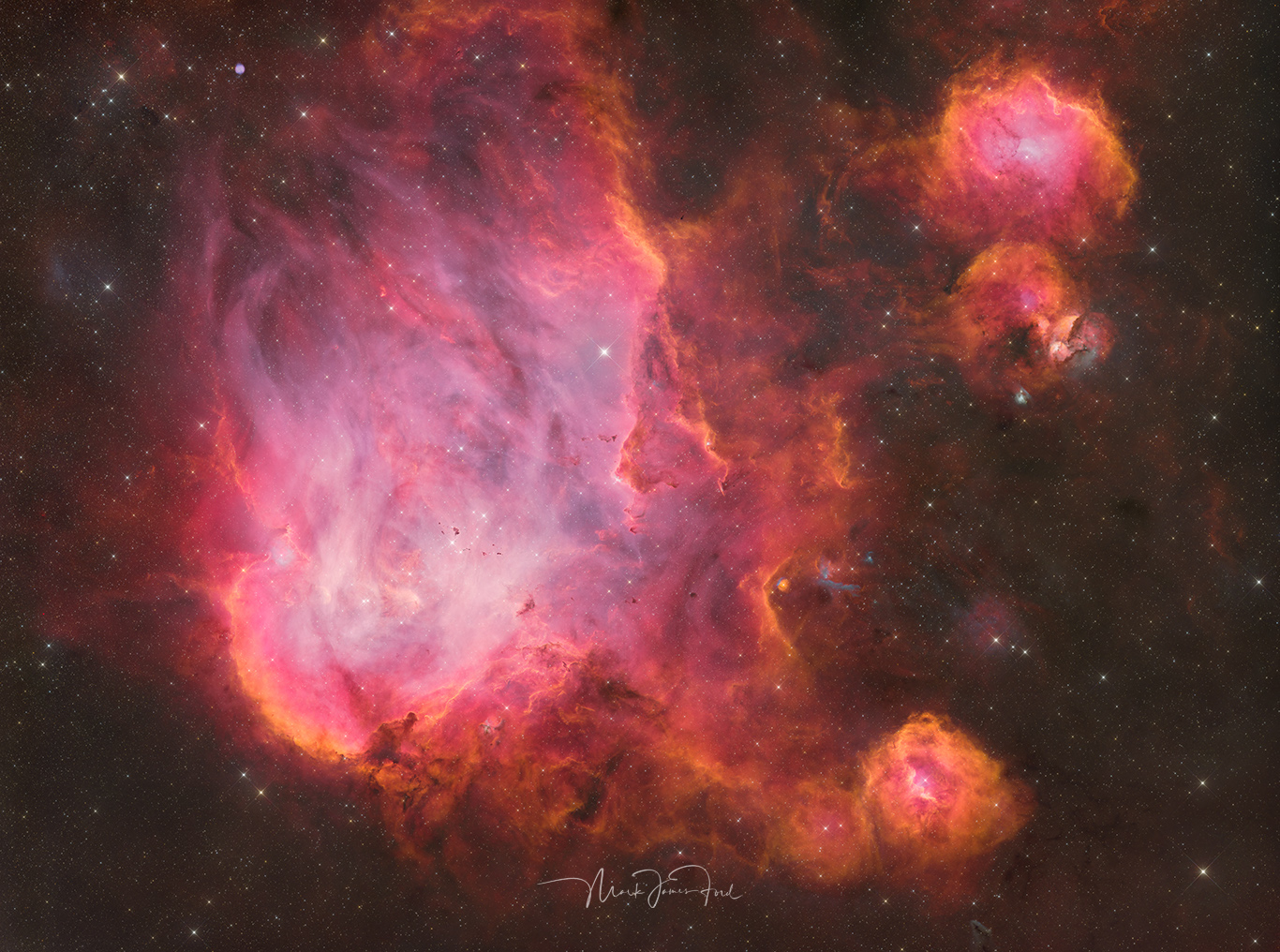
Running Chicken Nebula (IC 2944) with RCW 60a/b and RCW 61
Sprawled across the southern reaches of the Centaurus constellation, the Running Chicken Nebula—officially known as IC 2944—is a vast and complex star-forming region approximately 6,500 light-years from Earth. Rich in glowing hydrogen gas, dark dust lanes, and clusters of newborn stars, this luminous cloud is part of a larger H II region, where the raw material of stars is sculpted by radiation and stellar winds.
Its common name comes from a loose visual interpretation: when seen in wide-field images, certain dark patches and bright knots are said to resemble a chicken running across the starscape. But beneath this whimsical moniker lies a richly structured region of astrophysical interest, one that includes several cataloged components such as RCW 60a, RCW 60b, and RCW 61—distinct emission zones within the broader nebula complex, each energized by intense ultraviolet light from embedded O- and B-type stars.
At the heart of IC 2944 lies a striking young open cluster, Collinder 249, whose hot, massive stars illuminate the surrounding gas and carve it into rippling arcs and glowing filaments. These stars are responsible for ionizing the hydrogen in the nebula, causing it to radiate with the characteristic H-alpha emission—a vivid red glow that marks regions of active star formation.
One of the most intriguing features of IC 2944 is the presence of Bok globules—dense, dark clouds of cold gas and dust seen in silhouette against the brighter background. These compact, comet-shaped globules are potential stellar nurseries, though observations suggest that not all of them are actively collapsing into stars. The most famous set of these lies near the bright region associated with RCW 60, giving the nebula both a scientific and visual identity that has captured the attention of astronomers since the early days of photographic sky surveys.
To the north and west, RCW 61 extends the complex further, tracing the spread of ionized gas and young stellar populations across tens of light-years. Altogether, the Running Chicken Nebula is not a single monolithic object but rather a bustling neighborhood of interconnected emission regions, shaped by the interplay of radiation, gravity, and time.
In this vivid corner of the Milky Way, we glimpse the galaxy’s restless creativity—where clouds collapse, stars ignite, and the remnants of ancient matter are recycled into the next generation of suns.
IUn the upper left of the image the planetary nebula PK294-00.1 is also clearly visible.
The Ha, SII, OII, nIR and RGB data was collected on location at Hakos Guest Farm in Namibia.
PlaneWave Delta Rho 350
10Micron GM2000 HPS
Moravian C5S-100M
Gain 0/2750, F3.0, 1050mm
Total acquisition time: ca 6 hrs