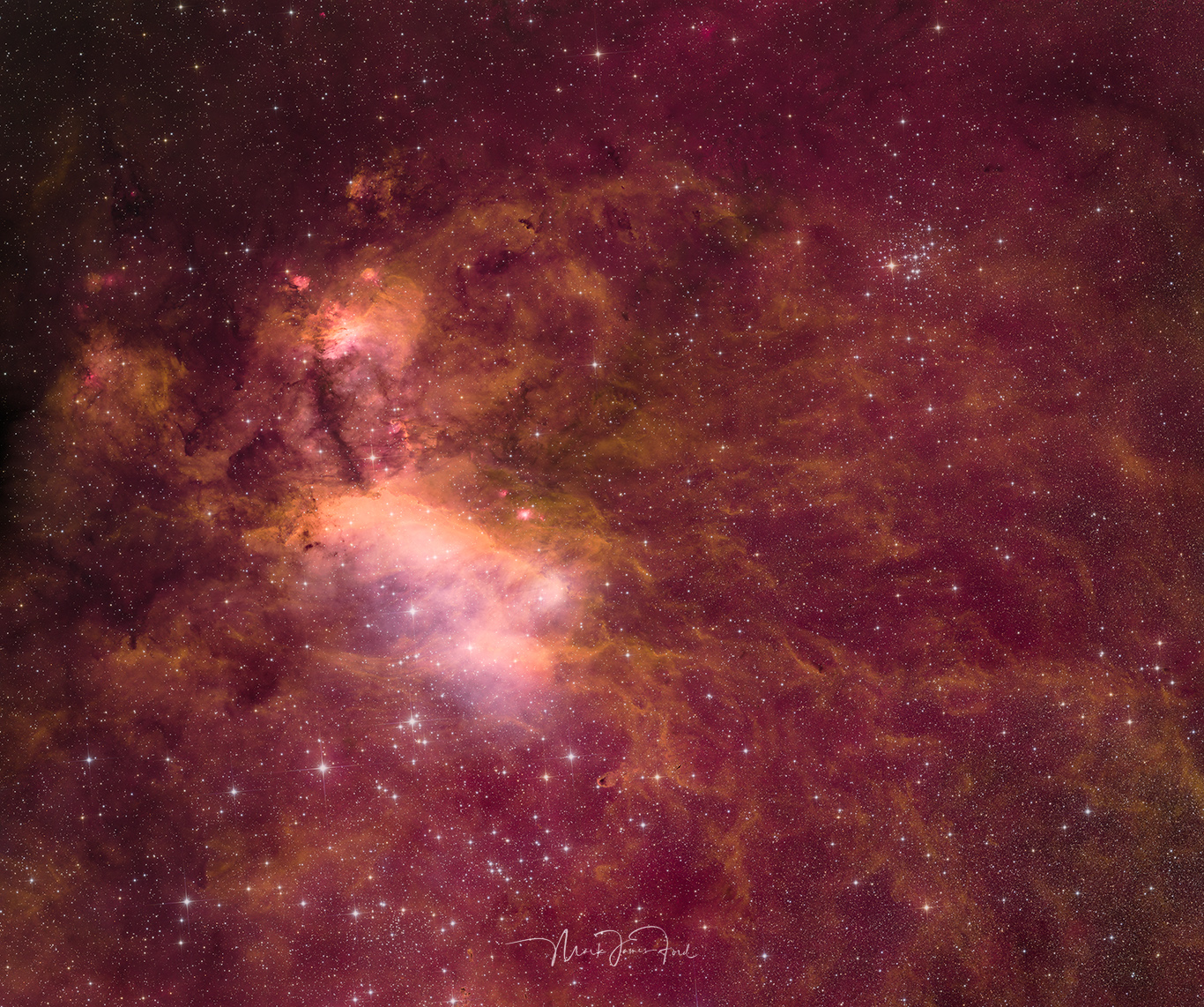
The Prawn Nebula / IC 4628
In the tail of the Scorpius constellation, lies a vast and radiant cloud of gas and dust known as the Prawn Nebula (IC 4628). Spanning over 250 light-years across, this colossal emission nebula is a quiet yet majestic cradle of starbirth.
Bathed in the searing ultraviolet light of massive, young stars within and around it, the nebula fluoresces with the unmistakable red glow of ionized hydrogen. This radiation not only illuminates the cloud but also sculpts it, carving elegant voids and subtle filaments throughout the region. From afar, its sprawling shape evokes the outline of a prawn, lending the nebula its name—though its true grandeur lies in the delicate interplay of structure, light, and motion unfolding across centuries.
Though it lies over 6,000 light-years from Earth, the Prawn Nebula is part of the rich star-forming complex known as the Scorpius-Centaurus Association, a fertile region where stellar life begins in clusters hidden behind veils of cosmic dust. Within its luminous folds, newborn stars stir to life, casting fierce winds and shockwaves that ripple through the nebula, continuously reshaping it.
Unlike more famous nebulae dominated by violent stellar remnants, IC 4628 is a scene of more subtle brilliance—a sprawling celestial reef quietly building the future. It is a place where time stretches long and slow, and where the beauty of creation is written in light across the canvas of the night. Befitting a more subtle and perhaps unusual rendition, the Ha emission data has been omitted and replaced by near-Infrared data (mapped to deep red).
The Infrared, SII, OII and RGB data was collected on location at Hakos Guest Farm in Namibia.
PlaneWave Delta Rho 350
10Micron GM2000 HPS
Moravian C5S-100M
Gain O/2750, F3.0, 1050mm
Total acquisition time: ca 11 hrs